
Why the future of retail depends on making sustainability commercially irresistible

There is one particular question that Harri Lockett returns to in her work, time and time again. Not “is this interesting?” but “is this actionable?” The distinction, as she’ll tell you, is everything.
Interesting ideas fill meeting rooms, but actionable ones build businesses.
Harri has spent more than ten years in corporate sustainability, working across agencies, FMCG brands and now one of the world’s most iconic department stores. The through-line across all of it has been connecting highly technical sustainability thinking to the parts of a business that actually sell things: communications, marketing and commercial teams. These people live and die by the numbers.
At Selfridges, that connection is front and centre. “What immediately appealed to me about the Circular Manager role,” she tells London Packaging Week, “was how closely tied it is to the commercial engine of the business. Traditionally, sustainability teams are often asking for budget, trying to get projects approved and building business cases around environmental impact or regulatory requirements rather than financial returns. What’s unique here is that commerciality sits at its core.”
That is a rarer thing in sustainability than it ought to be. And it is, Harri argues, exactly why Selfridges has been able to build something that works. The store’s circularity ambitions run deeper than most outsiders realise. Selfridges’ iconic yellow carrier bag, one of the most recognisable pieces of retail packaging in the world, is now made using fibre recovered from spent coffee cups collected in its own cafes and offices, upcycled through a closed-loop process with specialist partner James Cropper. The most visible thing a Selfridges customer walks out of the door carrying is itself a circular product. That is not a coincidence, but a philosophy.
Five years in the making
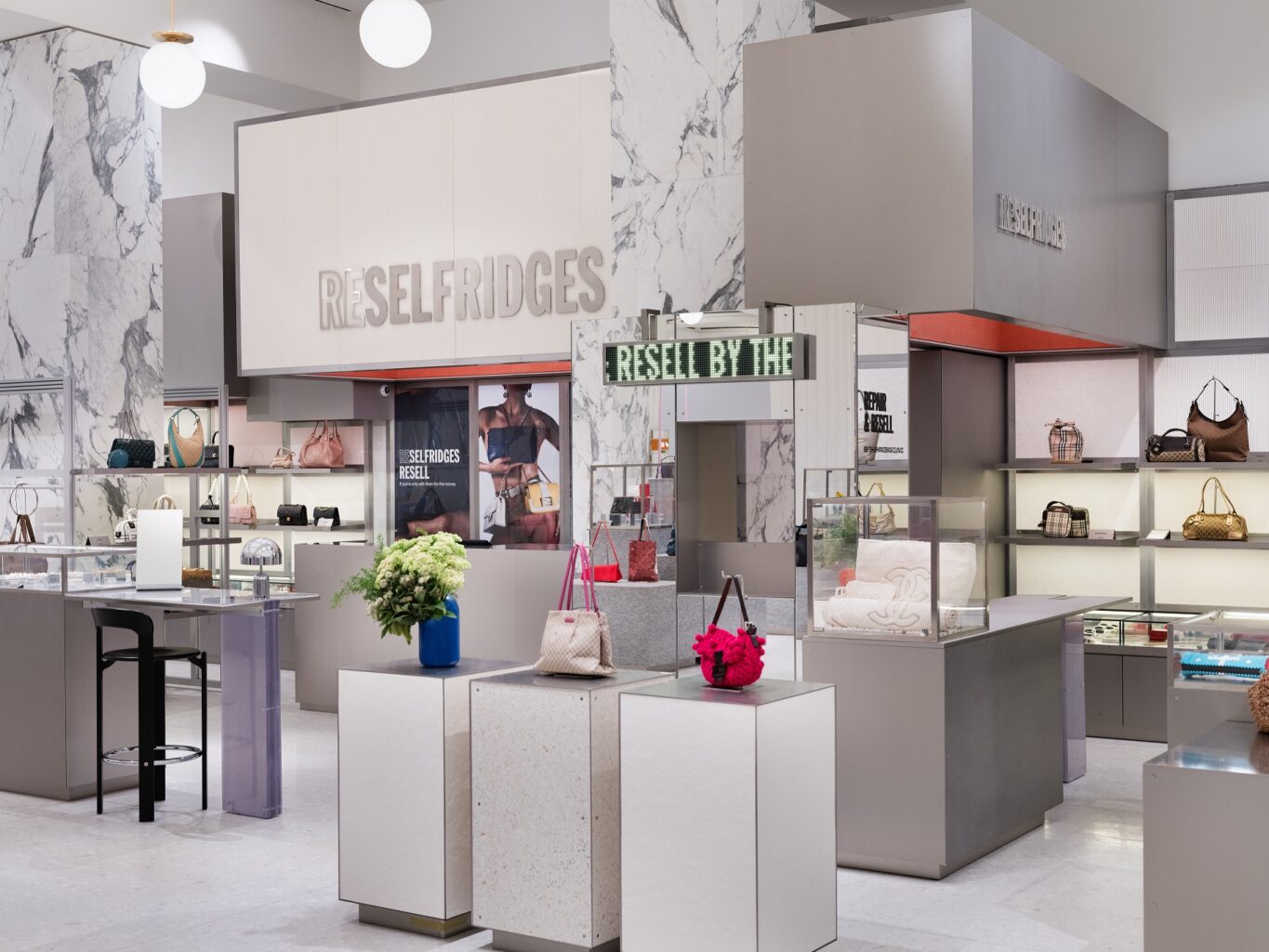
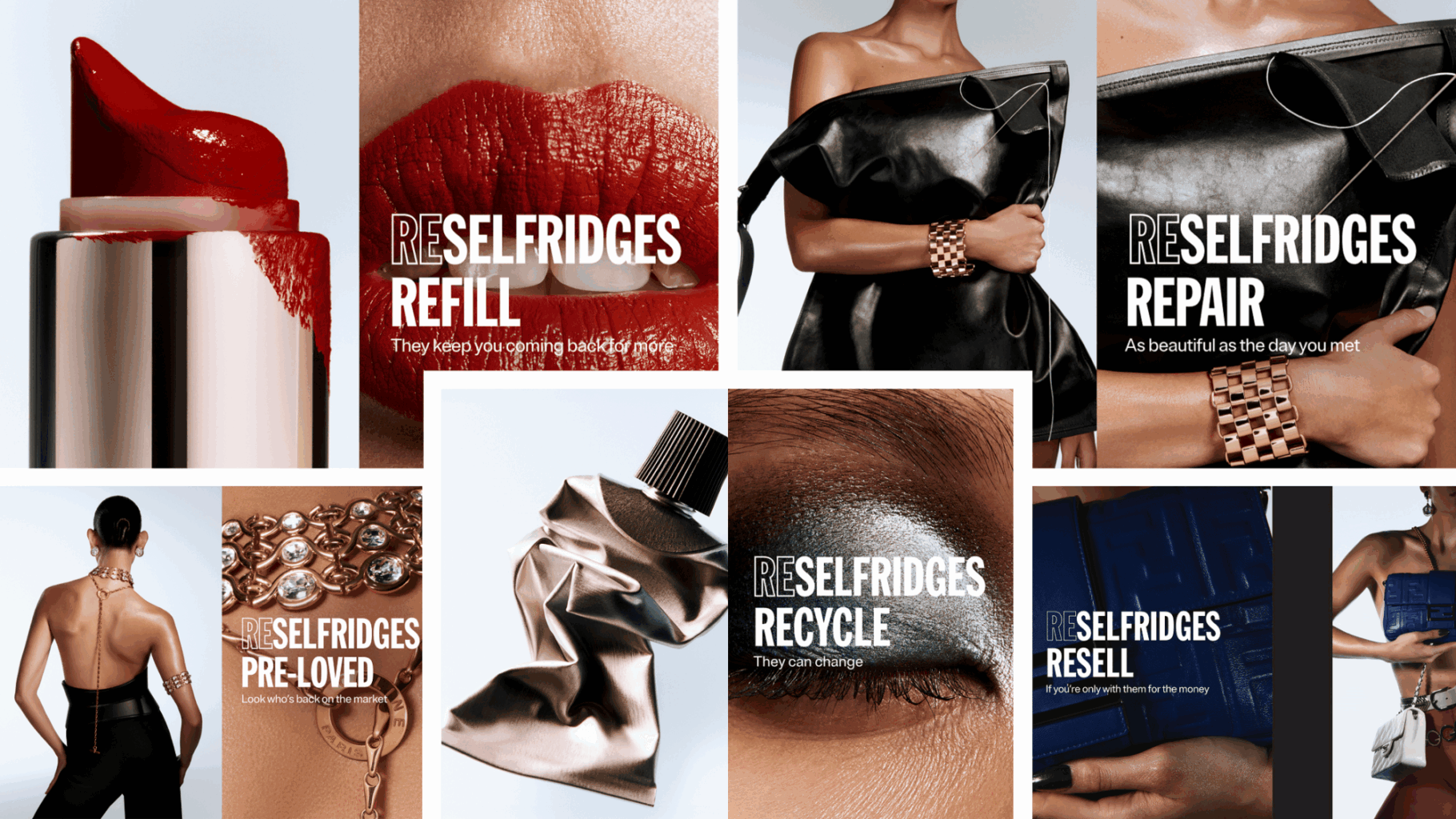
The circular offering Harri now manages, also known as Reselfridges, has been built over five or six years through patient investment, honest evaluation, and a willingness to walk away from what was not working. The pillars of it today are a pre-loved accessories business, particularly strong in handbags, watches and jewellery; a network of repair partners across the Oxford Street flagship; a buy-back scheme for luxury handbags; and, most recently, a beauty recycling programme launched across all stores in January.
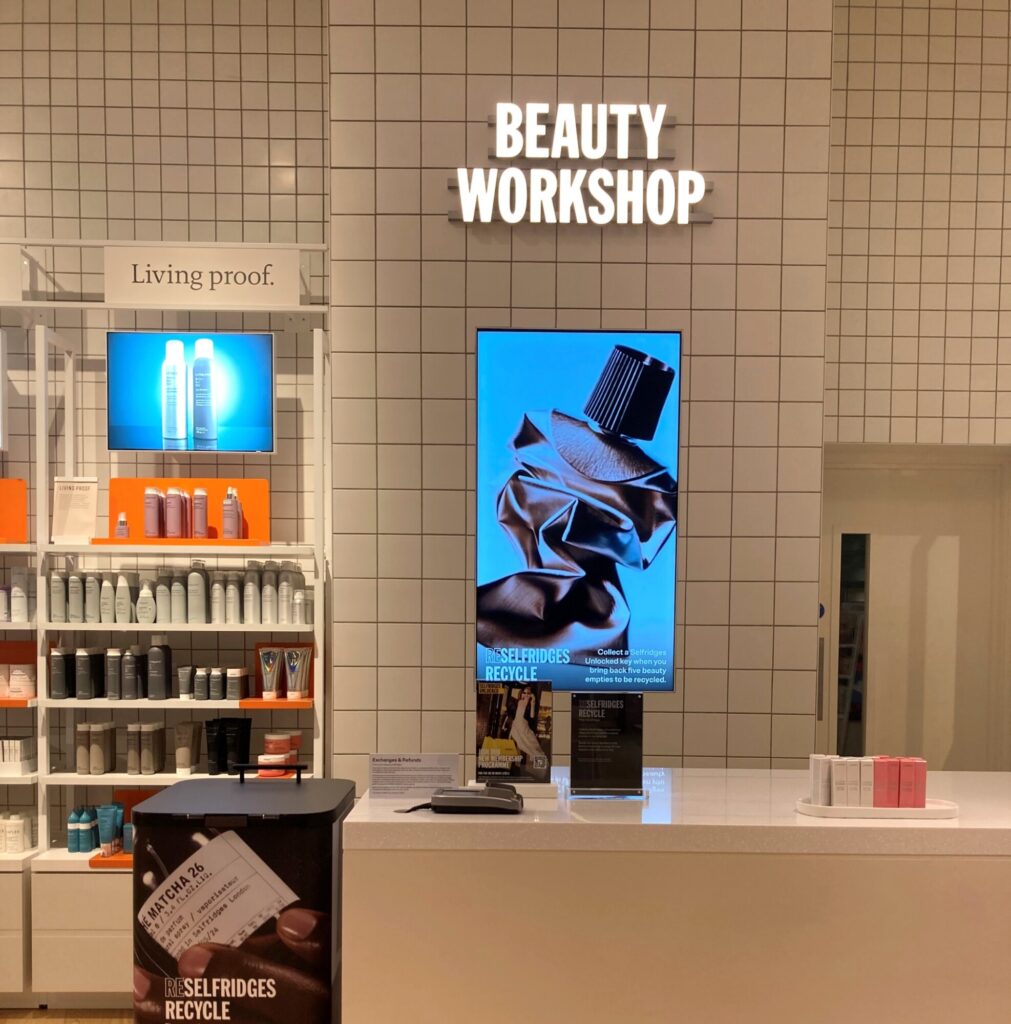
That last one is notable because it is the first circular initiative Selfridges has introduced without a direct commercial drive. Customers can return five empty beauty or fragrance products purchased from anywhere and earn ‘keys’ through the Selfridges Unlocked membership programme. It is an investment in habit, in loyalty, and in a longer relationship with customers who are already engaged. The commercial logic is there; it’s just operating over a longer arc.
“Circular products and services accounted for around £17.6m of sales in 2026,” Harri says. “That’s quite significant. It means we have a genuine seat at the table within that division and can continue investing in what works.”
Those sales do not happen in just a year; it is the result of consistent, incremental growth, tested and re-tested, with honest conversations about what the data is saying. “The team has done a brilliant job of testing, trialling and innovating over the years, while also being willing to move away from ideas that aren’t delivering results,” she adds. “The focus has always been on identifying what works best for both customers and the business.”
The advantage of trust
Pre-loved luxury is a crowded, increasingly sophisticated market, and the rise of vintage has demonstrated the appetite for it. But at higher price points, the question of authenticity becomes highly acute. A customer spending several thousand pounds on a second-hand handbag is not operating on blind faith alone.
“The trust that customers have in the Selfridges name is probably what does us the biggest favour in this space,” Harri says. “In the pre-loved handbag market, customers don’t always have the same reassurance everywhere they purchase from. Everything that comes through Selfridges is thoroughly authenticated. We know our brands exceptionally well and are deeply familiar with the luxury market. The trust we’re able to offer customers as a brand is hugely valuable.”
That trust also attracts a customer profile that might not otherwise have considered pre-loved. “We already have a customer base looking for luxury handbags,” Harri explains. “We haven’t had to stretch too far to find people who might be shopping for themselves but are also thinking about buying their daughter a first luxury handbag for an 18th birthday, and perhaps don’t want to make that full-price brand purchase. That’s where we see really lovely customer stories emerging.”
The deliberate invisibility of sustainability messaging
One of the most counterintuitive decisions Selfridges has made is also one of its most effective. The Reselfridges pre-loved space, which sits directly within the ground-floor accessories hall of the Oxford Street flagship. Positioned alongside Burberry, Chanel and Dior, it does not lead with sustainability, but with fashion.
“Our approach has leaned into a playful, tongue-in-cheek fashion-led identity rather than focusing heavily on sustainability,” Harri says. “In some respects, that’s exactly why we’ve gained so much traction. People don’t necessarily come to us as a sustainability destination. They come to us as part of the wider Selfridges experience, wrapped in that playful branding.”
The placement matters as much as the messaging. By refusing to separate the pre-loved offering from the main retail floor, Selfridges removes the sense of compromise that often clings to sustainable choices. A customer browsing the accessories hall does not feel they are making a sacrifice. The experience, service, and environment are identical.
Harri is pragmatic about what this means for the sustainability story, however. “After five or six years and seeing the growth we’ve achieved, we can probably start to strengthen the sustainability messaging and make those benefits clearer to customers.” It was always a deliberate step back, but space now exists to step forward.
Consumer research has sharpened the picture. Around a quarter of Reselfridges customers are what the team calls “informed insiders”, buying with explicit sustainability intent, scrutinising material composition and environmental credentials. Around 40% fall into the “curious majority”: open to more sustainable choices, but only when those choices are easy, accessible and comparable to a conventional shopping experience. “It’s really about understanding exactly who we’re speaking to,” Harri says.
The collaboration opportunity
Harri is enthusiastic about what happens when retailer and brand circularity strategies align. Last year, Selfridges worked with several major brands to bring their own circular initiatives into the store environment, building awareness and demonstrating that sustainable options are increasingly woven into the mainstream luxury experience.
The Burberry partnership is the example she returns to. “Through initiatives like ReBurberry, customers can have products repaired by artisans who originally worked on those items. Occasionally, we’re able to bring those artisans into store, helping customers extend the life of their luxury purchases.”
The repair becomes an event. A story in its own right. Something worth coming in for.
“What’s lovely about the space is how diverse and complementary the various services and offerings can be,” she says. “It creates a highly collaborative environment.” Retailers and brands are not competing over circularity. They are building something together, and the customer experience is all the richer for it.
The data problem nobody has solved yet
Ask Harri where the biggest gap in circular retail currently sits, and the answer is immediate. “The first thing that comes to mind is almost boring because we’ve been talking about it for years, but it’s reporting, tracking and data.”
As a retailer working across hundreds of brands, Selfridges is in a position to do something genuinely useful by pointing customers towards products containing meaningful levels of recycled content, or materials that take post-consumer waste and do something truly circular with it. The appetite is there, but the infrastructure is not.
“The challenge is creating consistency around tracking, information and certifications so that those claims can be communicated confidently and credibly to consumers,” Harri explains. “It’s an area that feels within reach, but once you dig into the practicalities, it’s still much further away than many people realise.”
Selfridges is working on this directly through a project called Reselfridges Listed, a curated online edit that will highlight products that meet specific criteria, such as containing 50% or more recycled content or carrying certifications the team has reviewed and is prepared to stand behind. Harri is honest about the scale of the task. “The amount of information, validation and detail required to present those claims clearly and responsibly to consumers is enormous. It’s a really exciting project, but it highlights just how challenging this space remains.”
The sustainability label question is one that the wider industry has circled for years. Harri sees value in a simple visual signal at the point of purchase, particularly for the curious majority who want to make better choices but are not going to do the research themselves. Getting there requires standards that are accurate, measurable, and genuinely proven. “It’s far more complex than it appears,” she says.
Commercial discipline as a philosophy
Harri is eight months into her role at Selfridges. She arrived in discovery mode, asking questions that more settled employees might have stopped asking. “I’ve always found that having the type of personality that asks, ‘Okay, but why?‘ and challenges whether there might be a different way of approaching something, is incredibly valuable. Simply posing those questions can start to shift conversations and gradually open people up to new opportunities.”
What she has found is a business unusually well set up for this kind of thinking. Circular products sit alongside the buying and commercial teams and are held to the same performance standards. “We have sales targets. We’re constantly asking questions: how did sales perform last week, did we hit targets across all stores, which locations overperformed or underperformed, and why? We’re always looking at whether we’re on track to achieve our annual goals and putting strategies in place to make sure we get there.”
That accountability is what gives sustainability real leverage inside a business. When circular performance is measured the same way as everything else, it stops being a values conversation and becomes a commercial one. Then, the business listens differently.
Her advice to anyone working in this space is grounded in exactly that discipline. “Keep commercial outcomes front of mind, but also be patient enough to allow those outcomes the time they need to materialise. Across all of our circular business pillars, sales figures started small and have seen consistent, incremental growth year after year. By years five and six, the value of those investments have become very clear.”
And always, underneath the strategy, the same question. Is it interesting, or is it actionable?
“I ask myself that question constantly to make sure I’m focusing on initiatives that genuinely move the business forward.”
It is, in the end, a very simple filter that does a great deal of work.
Harri Lockett will be speaking at London Packaging Week 2026, which returns to Excel London on 16 & 17 September. Register now to explore a conference programme featuring more than 90 expert speakers.
Check out our socials
The latest packaging projects
London Packaging Week smashes attendance record with 16% growth in 2026
A record 6,688 unique visitors attended London Packaging Week 2026, as more than 230 exhibitors and over 110 speakers helped deliver the biggest edition in the event’s history.

Prada, Jack Daniel’s, Heinz and Hotel Chocolat among London Packaging Week Innovation Awards winners
From Formula 1-inspired luxury engineering and interactive launch packs to everyday usability and recyclable flexible packaging, the 2026 London Packaging Week Innovation Awards reveal how brands are turning packaging into a source of practical, commercial and consumer value.