
Between bravery and balance: How packaging can lead with purpose

The packaging industry today finds itself at a fascinating crossroads. Sustainability, once the shining star of brand conversations and innovation, is no longer the sole focus for many companies navigating a challenging economic landscape. Yet despite shifting priorities and tightening budgets, the drive for meaningful progress remains; perhaps quieter, but no less determined. Innovation continues to push boundaries, not through flashy gimmicks but with purpose-driven solutions designed to meet real challenges.
Far from disappearing, sustainability has evolved. The industry has matured, shifting beyond trend-driven hype to a more nuanced and pragmatic approach to environmental concerns. It’s no longer just about grand gestures but about embedding sustainable thinking throughout every stage of design, production, and consumer experience. That shift, from performative to practical, was clearly visible throughout the judging process for this year’s London Packaging Week Innovation Awards, where thoughtful, incremental improvements often stood out more than sweeping reinventions.
“What’s encouraging is that sustainability is still lingering,” said Chris Allinson, Packaging Development Manager at Diageo. “It was very much on trend in recent years, and while a lot of consumers are probably less focused on it now, given the cost of living and the current economic climate, it’s still present.”

Innovation with purpose
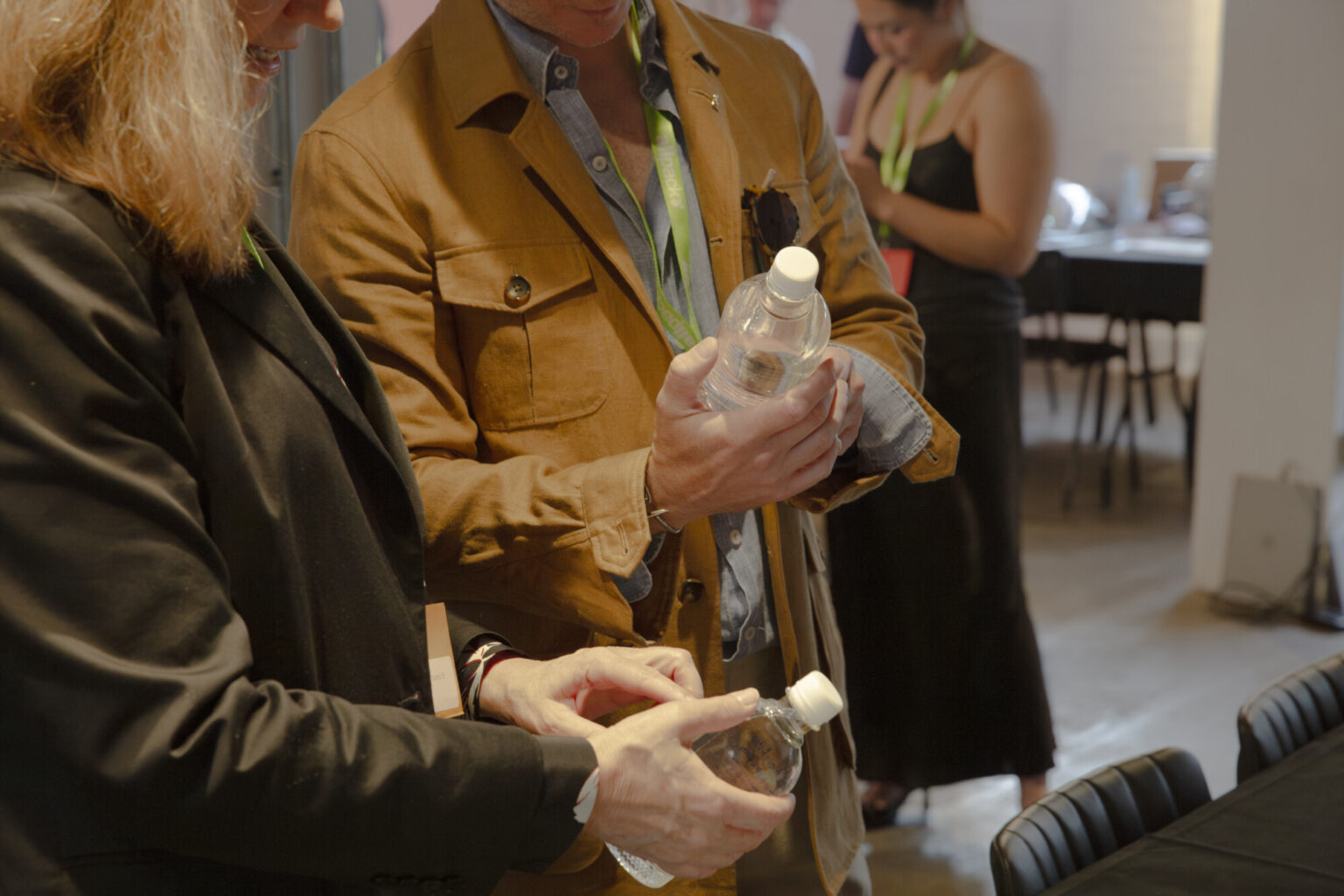
Chris is one of 18 industry leaders forming this year’s judging panel, which includes senior figures from global brands, sustainability experts, and regulatory specialists. With experience spanning luxury, FMCG, and innovation, the panel was tasked with evaluating entries based on functionality, impact, environmental credentials, and creative thinking. And if one theme emerged consistently throughout the day, it was the tension between bold ambition and cautious pragmatism.
“For me, innovation has to hit certain targets,” he added. “I’m not really one for gimmicks. Innovation needs to have purpose.” One example he highlighted was the Time:Space Collection from The Macallan, which he described as “doing their own thing,” showing what purposeful innovation looks like in a crowded field.
Chris also highlighted Rhyme & Reason as an example of how real progress doesn’t always need to be radical to be meaningful. “It’s encouraging to see people doing the basics well,” he said. “Their 100% recycled plastic flip-top cap and bottle is not necessarily groundbreaking, but the fact that it’s possible now, and so few brands are doing it, makes it stand out.”
And in truth, the brand has done more than just make it possible. Haircare brand Rhyme & Reason, owned by SLG Brands, has achieved its goal of using 100% recycled plastic, not only for its bottles but also for its flip-top caps. “A lot of people are leaning into sustainability as a way to promote their brand,” he noted, “but smaller components like caps are often overlooked because they use such a small amount of material. So, it’s good to see attention being paid there.”
Chris also pointed to the adoption of fibre-based tubs and lids by brands like Flora as an encouraging step forward. “The technologies themselves aren’t necessarily new,” he said, “but it’s really encouraging to see big brands starting to adopt them.”
But amid the celebration of progress, he acknowledged the fear many brands still harbour around making bold sustainability claims. “I was chatting to someone earlier, and I think as a brand, you’ve got to be quite brave. There’s a lot of greenwashing out there. Many brands are hesitant to step into that territory. They’re scared of making bold sustainability claims.”
That’s why, in his view, brands like Rhyme & Reason stand out, not for radical reinvention, but for making credible, demonstrable improvements. “If other brands see that, hopefully they’ll follow suit,” he said. “But there are still many brands I’m aware of that are too afraid to make those bold moves, even though they’re fully capable of putting those kinds of components on the market. So yes, having a bit of bravery really matters.”
Collective responsibility
Chris reflected on the balance brands must strike between competitive edge and collective progress. “As a brand, you want to be first to market. You want to utilise a new technology, material, or format to gain a competitive edge. However, particularly in the area of sustainability, you also want to encourage others to follow suit. Striking that balance is difficult.”
And then, of course, there’s the commercial reality: Sustainability, unfortunately, generally comes at a cost. You’re often eating into your margins to deliver it. So, who then absorbs that cost? If you’re developing a new material or aiming to be first to market, the scale may not yet exist to make it viable. That’s where bravery comes in. You have to trust that the consumer will buy into it.”
Yet even consumer intent can’t be taken for granted. “While most consumers say they want to make sustainable choices, when it comes to cost, especially outside of premium categories, it becomes much harder for them to follow through.”
The lack of regulatory clarity is just one piece of a much larger puzzle. Even with the right materials and well-intentioned design, the success of sustainable packaging ultimately depends on factors far beyond a brand’s control. Without the right infrastructure, even the most responsibly designed formats can fall short of their potential. A compostable film is only effective if consumers know how to dispose of it, and if there’s a facility to process it on the other end. Likewise, a recyclable pack means little if it ends up in general waste due to confusion, apathy, or lack of access.
It’s a reminder that packaging doesn’t exist in isolation – it’s part of a wider ecosystem. One that spans policy, waste management, consumer behaviour, and education. To drive real change, Chris argued, the entire system needs to evolve in tandem. “You almost need all the planets to align,” he continued. “You need infrastructure. You need educated consumers who are willing to change. Recycling rates are still too low to make the system work effectively. People need to adopt new models, such as refill systems. We have to rethink the way we consume.”
And that rethinking must be collective. “Everyone has a role to play. Brands, governments, infrastructure, and consumers, too. In the UK, there’s a lot of variation in infrastructure, which can be confusing for people. Then there’s the question of consumer willingness to recycle or reuse, which adds another layer of challenge.”
For brands, the obligation isn’t just to provide the right options, but to communicate their value. “We have a responsibility not only to offer solutions, but also to help educate. And that’s not just the job of R&D, it’s on the whole brand team: the marketers, the brand managers, everyone involved.”
Rethinking materials
That courage to challenge norms is just as important in design and format decisions. “When you think about premium drinks, glass bottles with outer cartons are the traditional, expected packaging,” he said. “It’s nice to see brands now experimenting or exploring alternative materials and formats beyond those established norms.”
Still, that experimentation brings its own complications. “The challenge for me, as a consumer, is figuring out what the right choice is for that product, taking into account the cost, sustainability, and functionality. Is glass the right choice? Is metal? Is plastic? It’s hard to tell. And that’s coming from someone in the industry. So, imagine how confusing it is for consumers.”
The complexity is heightened by competing narratives around materials. “Every material has its advocates. Glass has its case. Plastic has its case. It really is horses for courses. You can’t say any one material is the best across the board.”
Even within a single category, the picture is nuanced. “Take milk, for example. Glass bottles work really well. There’s a strong reuse and return infrastructure behind them, and clear glass is infinitely recyclable. But then you also have HDPE plastic milk bottles. And to be fair, that’s probably one of the best recycling success stories in the plastics space.”
Despite the science, public sentiment can make it difficult for brands to choose plastics, even when they’re the most logical choice. “It’s really difficult right now to make a strong case for plastic,” Allinson said, “even though, scientifically and objectively, it can be one of the best solutions for a number of applications. But the mood music around plastics is overwhelmingly negative. Plastics are ‘bad.’ Plastics are ‘evil.’ That’s what many consumers believe, and they don’t want to see them in any context.”
Despite all of this, Chris remains optimistic and believes platforms like the London Packaging Week Innovation Awards play a critical role in driving progress. “Some of the entries today are genuinely outstanding. But if no one is highlighting or rewarding that kind of work, how do we keep those innovators motivated?”
Recognition, he believes, is a vital part of the ecosystem. “Platforms like this, where people get to share, promote, and be recognised for doing good work, are essential. They help drive progress, and they give credit where it’s due.”
In a space as complex as packaging, where the answers are rarely absolute, that recognition helps fuel a more honest and collaborative conversation—one that prizes action over perfection and purpose over performance.
The London Packaging Week Innovation Awards will return as part of London Packaging Week, taking place on 15 & 16 October 2025 at Excel London. From purposeful design to sustainable innovation, the show celebrates the ideas shaping the future of packaging across beauty, drinks, FMCG, and luxury.
Join the conversation. Champion the progress. Be part of what comes next.
Check out our socials
Lorem ipsum dolor sit amet, consectetur adipiscing elit Lorem ipsum dolor sit amet, consectetur adipiscing elit
The latest packaging projects
London Packaging Week smashes attendance record with 16% growth in 2026
A record 6,688 unique visitors attended London Packaging Week 2026, as more than 230 exhibitors and over 110 speakers helped deliver the biggest edition in the event’s history.

Prada, Jack Daniel’s, Heinz and Hotel Chocolat among London Packaging Week Innovation Awards winners
From Formula 1-inspired luxury engineering and interactive launch packs to everyday usability and recyclable flexible packaging, the 2026 London Packaging Week Innovation Awards reveal how brands are turning packaging into a source of practical, commercial and consumer value.