

Movopack: The Italian start-up rewriting the rules of packaging – and winning hearts at London Packaging Week
On the second morning of London Packaging Week, as the aisles began to thicken with designers, buyers, sustainability leads and innovation scouts, a small but magnetic crowd formed at the Supplier Gallery. In a show celebrated for its aesthetics, engineering, luxury storytelling, and technical ingenuity, one winner stood out for a reason altogether different. It wasn’t just a new material. It wasn’t a slightly lighter box. It wasn’t a marginal efficiency.
It was a system.
A rethink.
A challenge to the very foundations of how e-commerce packaging works.
When Movopack and Decathlon Italia were announced as the Supplier Gallery Winner, the applause felt less like a nod to novelty and more like the industry recognising a shift: a future where packaging doesn’t end in the recycling bin, but begins a circular life of 20, 30 or even more journeys.
For Eleonora Protopapa, Movopack’s Chief Marketing Officer, the win was more than a trophy. It was validation. “It was a very positive show for us,” she reflects. “We already have meetings being booked. Our main objective was brand awareness, lead generation, and initial customer acquisition. And in that respect, it was exactly what we hoped for – especially as this is one of our first real-life touchpoints in the UK since expanding here late last year.”
Yet the success at London Packaging Week was simply the visible moment in a much larger story – one that starts with a deceptively simple idea: why should packaging be used once?
The reuse revolution
In an industry dominated by century-old incumbents, the rise of reusable packaging has felt inevitable yet strangely elusive. The logic has always been compelling: reduce waste, reduce emissions, reuse assets, lower long-term cost. And yet, adoption has lagged behind rhetoric.
That’s because innovation was never just about the product. It was about the system.
The logistics.
The refurbishment.
The customer experience.
The economics.
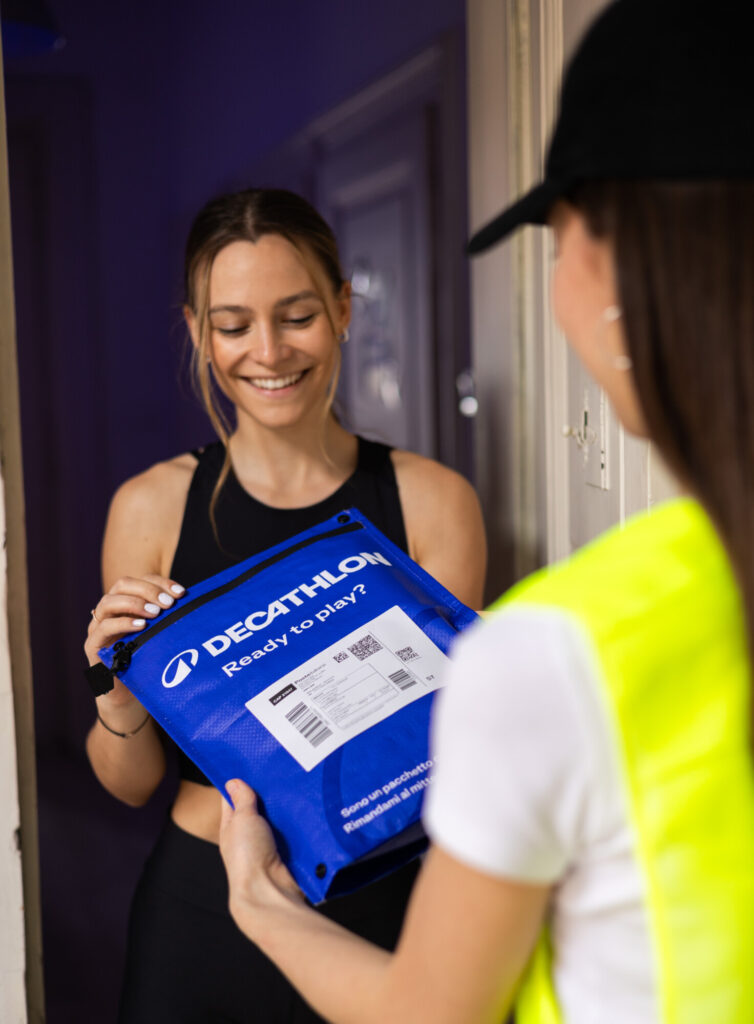
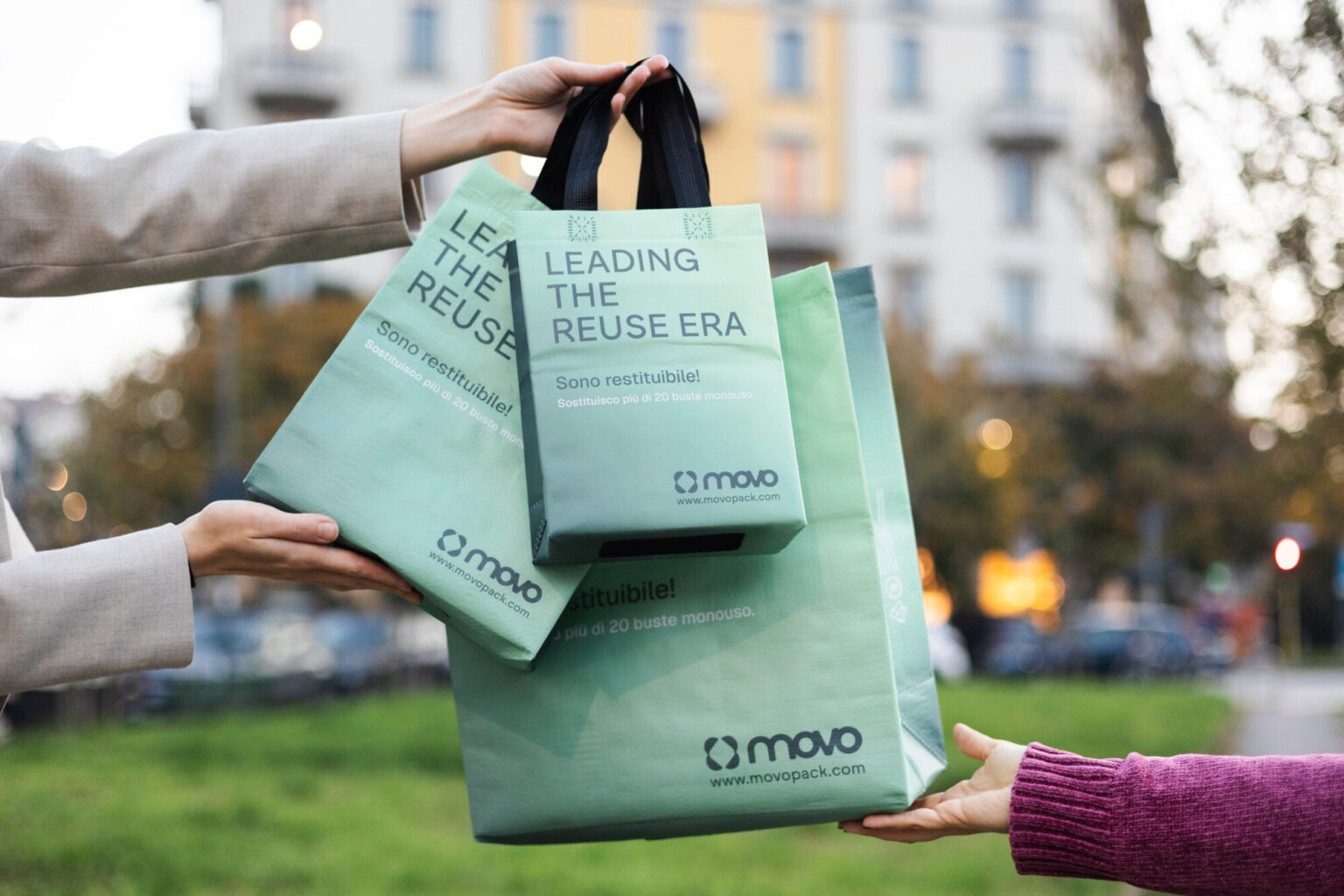
Movopack understood that from day one. Its Packaging-as-a-Service (PaaS) model offers not only the physical packaging – designed to be reused more than 20 times – but also full end-to-end management: reverse logistics, refurbishment, sanitisation, redistribution, and live data tracking, as well as support with communication and promotion of the project.
“People often focus only on the material,” Eleonora explains. “But here, the innovation is not just in the product – it runs through the full business model. That’s how it distinguishes itself from anything else at the show.”
The numbers are startling.
An independently verified Life Cycle Assessment shows that each Movopack unit reduces CO₂ emissions by up to 84%, packaging waste by 98% compared with a cardboard box made from 70% recycled paper, and dramatically cuts energy and water consumption. In a world of incremental sustainability claims, these are leaps.
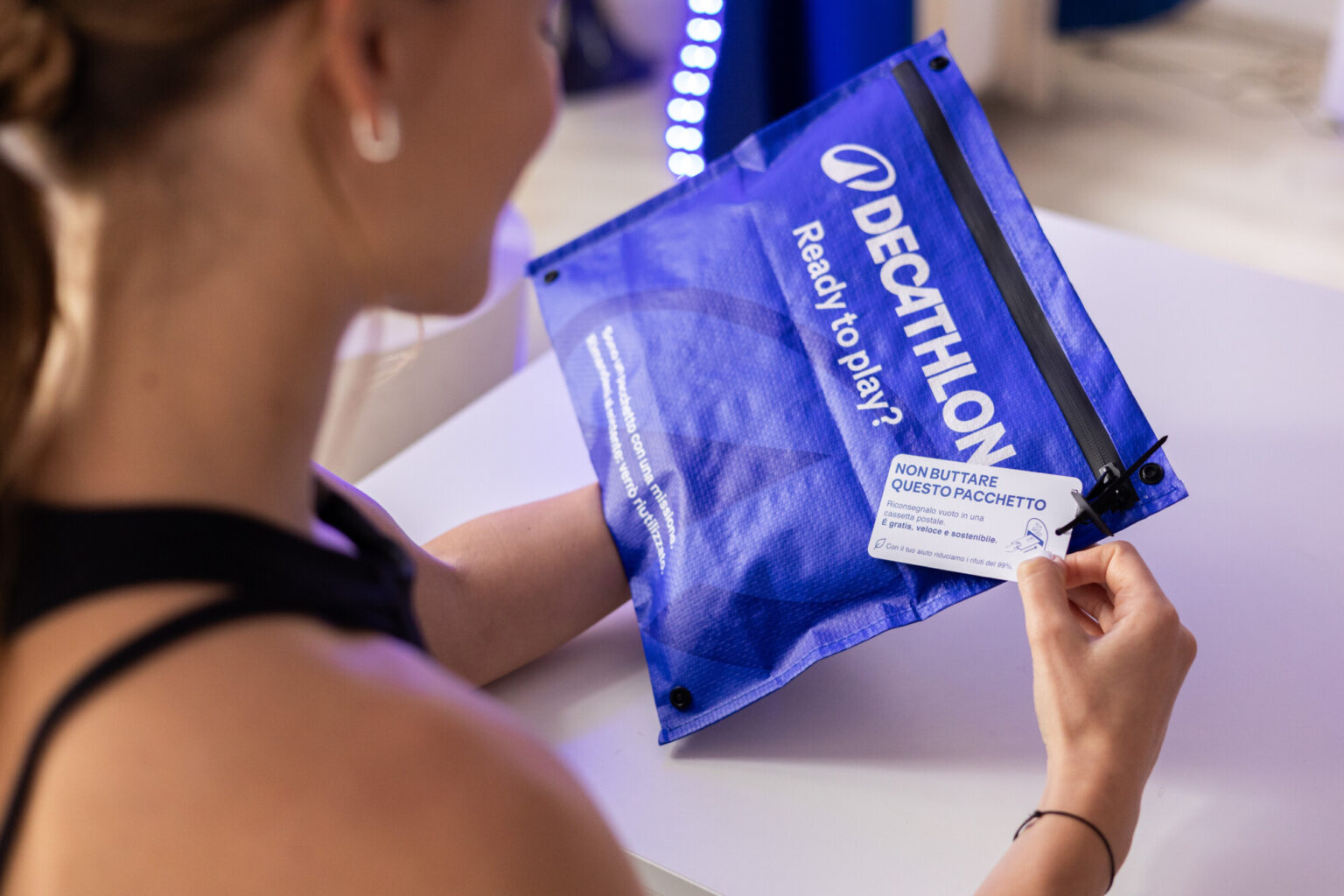
But perhaps the most genius part of the system is that, for the consumer, it’s effortless. After unboxing their purchase, they fold the packaging flat and drop it into any postbox, or partner stores, across Europe, free of charge. Movo handles the rest.
“Many people assume reusable systems are complicated or expensive,” Eleonora says. “But in the long run, they actually save brands money. You reuse packaging, cut single-use costs, and are exempt from upcoming EPR regulations. The economic evidence is just as strong as the environmental one.”
From Italy to Europe: How Decathlon became the proof point
While Movopack operates across Europe, its boldest partnership so far is with Decathlon Italia, the sports retail giant whose scale makes any sustainability initiative immediately meaningful.
The partnership began as many modern collaborations do – a conversation, a spark of interest, a meeting at an innovation fair. What followed was a model example of true co-creation.
“We build the packaging entirely around the customer’s needs,” Eleonora explains. “Dimensions, materials, opening mechanisms, design – everything is bespoke. We don’t offer a standard box with our logo. The packaging becomes their brand moment.”
This distinction matters.
Many reusable packaging systems in Europe rely on generic bags printed with the supplier’s identity. Movo flips the dynamic: the packaging becomes part of the brand’s storytelling, not an interruption of it.
“Think about receiving a Decathlon order,” Eleonora says. “If it arrives in a generic reusable pack, the emotional effect is lost. Instead, we wanted the customer to experience something that feels premium, aligned, and considered.”
The Decathlon pilot began with a test phase – a necessary step for any retailer managing vast operational complexity. The early results were immediately promising: a 26% organic return rate, achieved without incentives, purely through consumer goodwill and clear instructions.
“That number is extremely significant,” Eleonora notes. “Especially because, with Decathlon, we didn’t have access to all the touchpoints we would normally use to guide behaviour – like transactional emails or website pop-ups. So, we had to get creative.”
Movo added communications directly onto the packaging:
A message printed on the security seal.
A flyer inside the parcel explaining the return process.
A sticker reinforcing the instruction.
It worked.
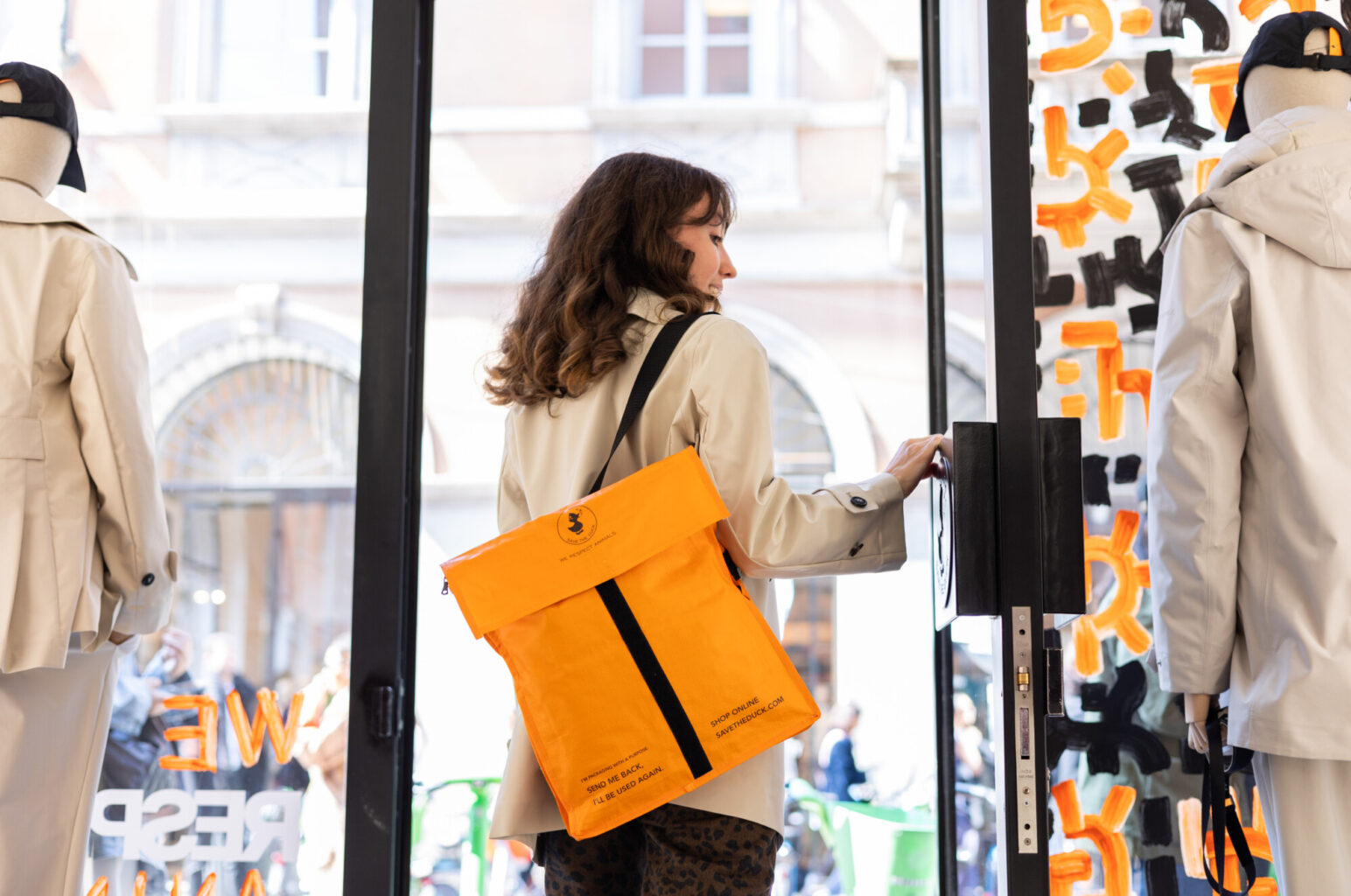
The pilot will expand into retail, with in-store collection points and reusable shoppers now in development. The Decathlon partnership is now becoming the backbone of Movopack’s social proof, especially as the company turns its attention to the UK.
Crossing the channel: Why the UK is Movopack’s next big bet
With one of the most mature e-commerce ecosystems in the world, the UK represents both a huge opportunity and a complex challenge.
“The UK has a higher buying power than Italy,” Eleonora says. “Our price points are more competitive here. And the volume of e-commerce is three times.”
Yet entering a new market requires more than logic and LCA data. It requires trust.
“In Italy, we have major brand recognition thanks to Decathlon and other strong partners,” she notes. “In the UK, we’re new. So, the challenge is building social proof — getting that first major brand that becomes the reference point for the rest.”
London Packaging Week was therefore a strategic milestone – a moment to gather leads, build visibility, and let UK retailers experience the system firsthand.
“It was one of the first times we got real-life touch with the UK audience,” Eleonora says. “And we’ve already booked for next year.”
Beyond sustainability: A business model that strengthens brands
For all the environmental benefits, what makes Movopack truly compelling is how it enhances a brand’s relationship with its customers.
If a consumer returns packaging via a postbox or brings it back to the store, they can be rewarded with discounts, loyalty points, or incentives. These incentives increase average order value, repeat purchase behaviour, and footfall to physical retail.
“You can position yourself as a sustainable brand,” Eleonora explains. “You increase customer retention. You tell a story your audience wants to hear. And you impact key business metrics directly.”
In a world where packaging is often seen as a commodity, Movo turns it into a driver of engagement, loyalty and narrative.
Operations, touchpoints, and the real work of change
The biggest barriers to adoption are rarely philosophical. They’re operational.
“When you introduce something new, even if it’s more efficient than cardboard, you’re disrupting your customer’s processes,” Eleonora says. “So the smooth transition is essential.”
Movo’s operations team collaborates directly with the retailer’s logistics and warehouse teams to ensure a seamless onboarding process. KPIs are set. Return rates are monitored. Tests are run.
Touchpoints become critical.
A sticker can shift behaviour.
A sentence on a seal can drive action.
A small flyer can unlock circularity at scale.
These micro-details accumulate into macro impact – turning return logistics from a theoretical idea into a living, functioning system.
A mindset shift: From waste to worth
For Eleonora, the emotional core of Movopack’s mission lies in simplicity.
“While customers can repurpose the packaging for gym gear or storage, the real impact happens when they return it,” she says. “Every return means significantly less CO₂, less energy, and less water used – a simple action that keeps the system truly circular.”
And that is the essence of the movement Movopack is building. Not guilt, or obligation, or complicated sustainability dashboards. Simply a better choice made easy.
A circular future, delivered
As the industry pushes toward net-zero goals, EPR compliance, waste reduction and the reinvention of delivery systems, Movopack feels less like an alternative and more like an inevitability.
The win at London Packaging Week wasn’t just a vote for a product. It was a vote for possibility – for a world where packaging doesn’t end in the bin, but begins a journey.
A world where brands save money, strengthen relationships, and reduce their footprint.
A world where consumers participate effortlessly in circularity.
A world where the box itself isn’t the end of the story, but the beginning.
“We know the product is valid, and we know the model works,” Eleonora says. “Now it’s about bringing that same impact to the UK, just as we’ve done in Italy.”
Judging by the energy in the aisles of London Packaging Week – and the growing list of brands lining up to talk – that future might be closer than anyone imagined.
Check out our socials
Lorem ipsum dolor sit amet, consectetur adipiscing elit Lorem ipsum dolor sit amet, consectetur adipiscing elit
The latest packaging projects

Etia: Redefining beauty for everyone
Born from a lived experience of blindness, Etia will reimagine beauty packaging as elegant, tactile, and truly inclusive for everyone.

London Packaging Week 2025 welcomes record visitor growth
London Packaging Week 2025 sees 15% growth, bringing 5,752 visitors together to celebrate innovation, sustainability, and the future of packaging.